

2025级博士生楚雨晨发表CEJ:碘空位工程BiOI导向选择性单线态氧生成用于过氧乙酸活化实现高通量抗生素降解
第一作者:楚雨晨
通讯作者:曾光明教授、周成赟副教授
论文doi:https://doi.org/10.1016/j.cej.2026.177900
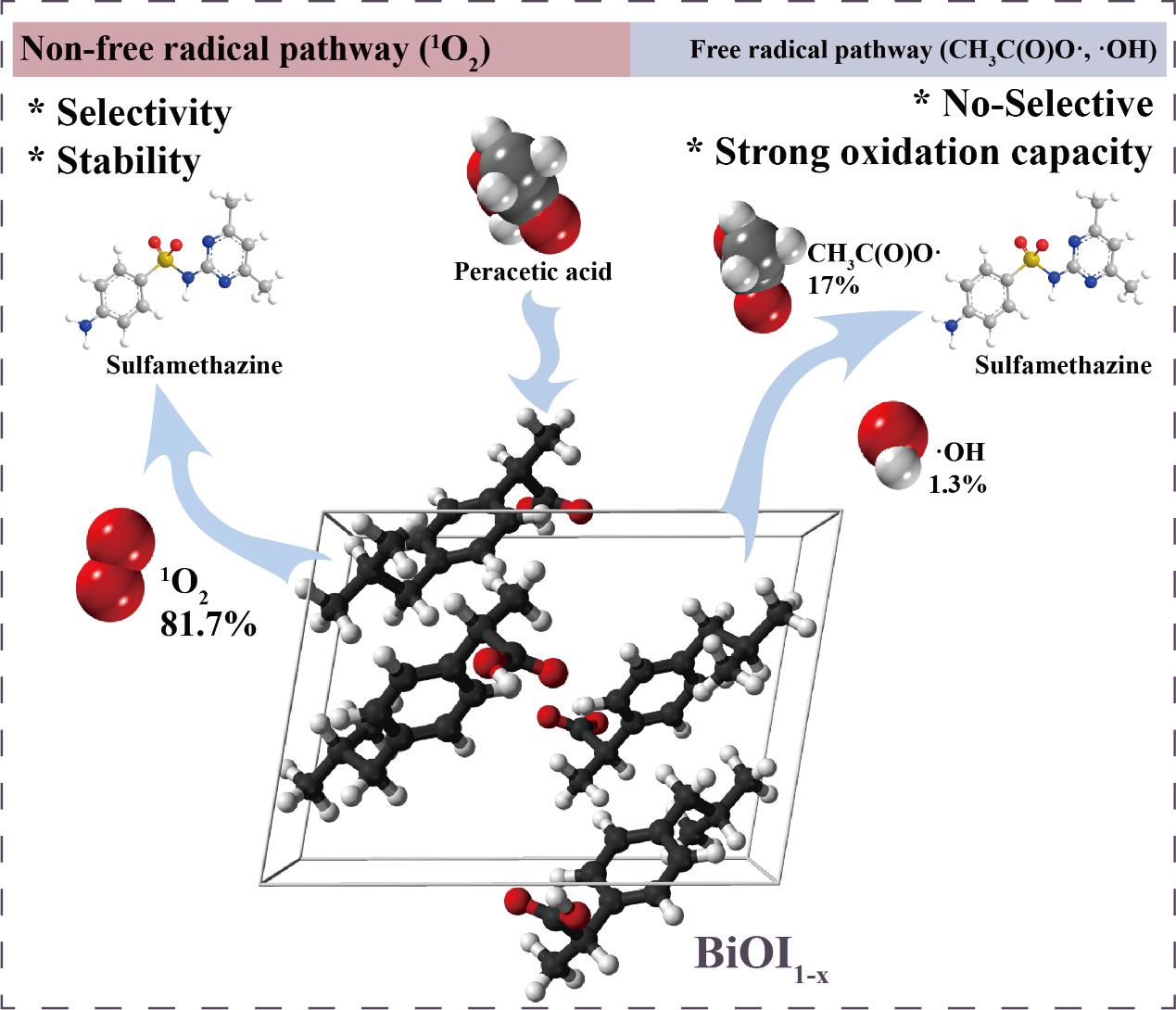
全文速览:传统的自由基主导的高级氧化过程(AOPs)通常存在非选择性去除和高能耗的问题,阻碍了它们对抗水中抗生素污染的效率。通过水热化学计量调制(BiOI1-x)合成了碘缺陷可控的碘氧化铋(BiOI)纳米片。这种缺陷形成了大量的碘空位,被证明是活化过氧乙酸(PAA)降解磺胺二甲嘧啶(SMZ)的特殊催化剂。这些定制的碘空位从根本上调节了活性物种(ROS)的产生途径,将主要的活性物种从自由基(如•OH、CH3C(O)O•)转移到非自由基(1O2)。这种1O2驱动机制使SMZ在30分钟(0.159 min-1)内完全降解,明显优于化学计量比的BiOI。BiOI1-x/PAA体系在宽pH范围(3-9)和不同水成分的存在下表现出强大的催化活性,突显了其实际潜力。至关重要的是,作为催化膜固定,BiOI1-x表现出卓越的连续流动性能,在低催化剂负载(5 mg cm-2)和高水通量(94 L m-2 h-1)的情况下,在前5小时内实现了100%的SMZ去除率。机理研究表明,引入的碘空位介导定向电子转移,引导PAA活化产生1O2。全文通过化学计量控制建立了一种合理的缺陷工程策略,以设计高效和选择性的高级氧化过程,为抗生素污染的水修复提供了一种潜在的解决方案。
图文导读:
摘要图:
催化剂的表征
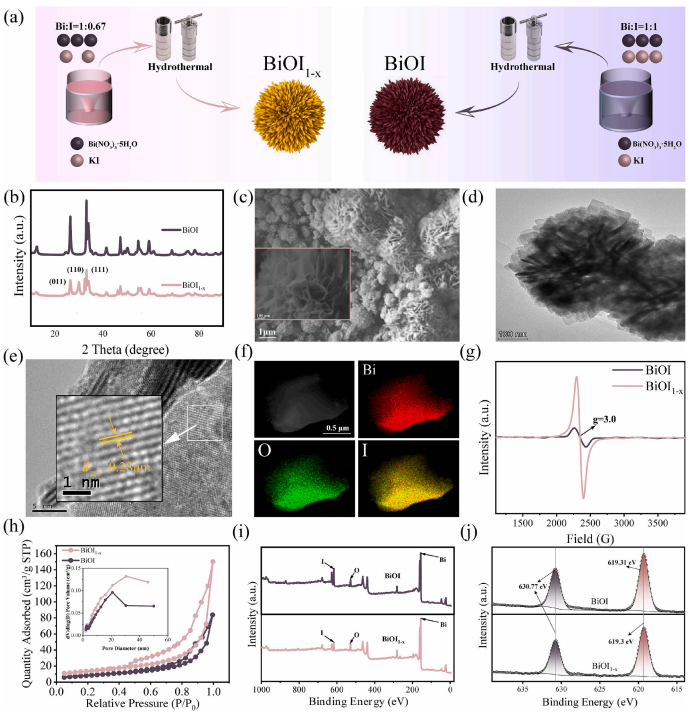
Fig. 1 (a) Synthesis procedures of BiOI and BiOI1-x, (b) XRD analysis of BiOI and BiOI1-x, (c) SEM analysis of BiOI1-x, (d) TEM analysis of BiOI1-x, (e) HR-TEM analysis of BiOI1-x, (f) TEM elemental mappings of BiOI1-x, (g) EPR spectra of BiOI and BiOI1-x, (h) BET analysis of BiOI and BiOI1-x, (i-j) XPS analysis of BiOI1-x.
性能测试:
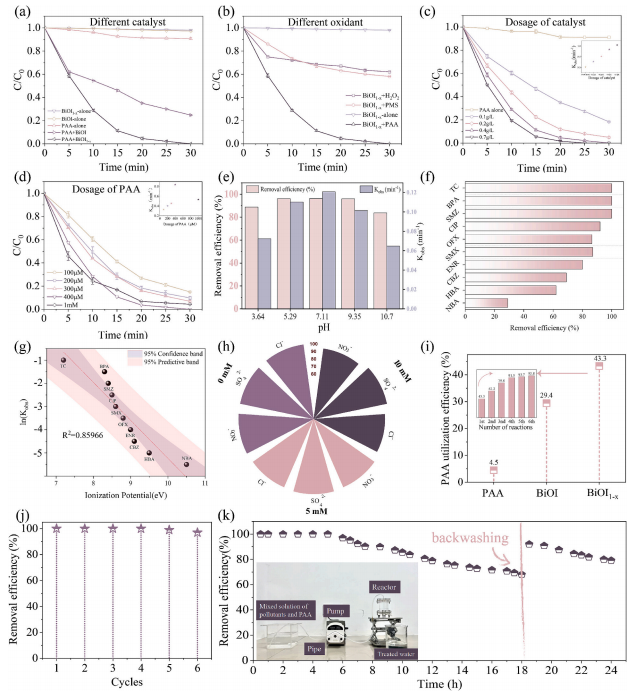
Fig. 2 (a) Comparison of degradation of different catalyst, (b) comparison of oxidant types, (c) catalyst dosage, (d) dosage of PAA, (e) effect of pH on degradation, (f) degradation of different pollutants, (g) relationship between IP and lnk values, (h) effect of different concentrations of ions on degradation, (i) relationship between PAA consumption and degradation processes, (j) number of cycles, (k) continuous flow experiments. Reaction conditions: [SMZ] = 10 mg L-1, [PAA]0 = 400 μM, [catalyst]0 = 0.4 g/L, pH0 = 6.83, and T = 25°C
活性物种鉴定:
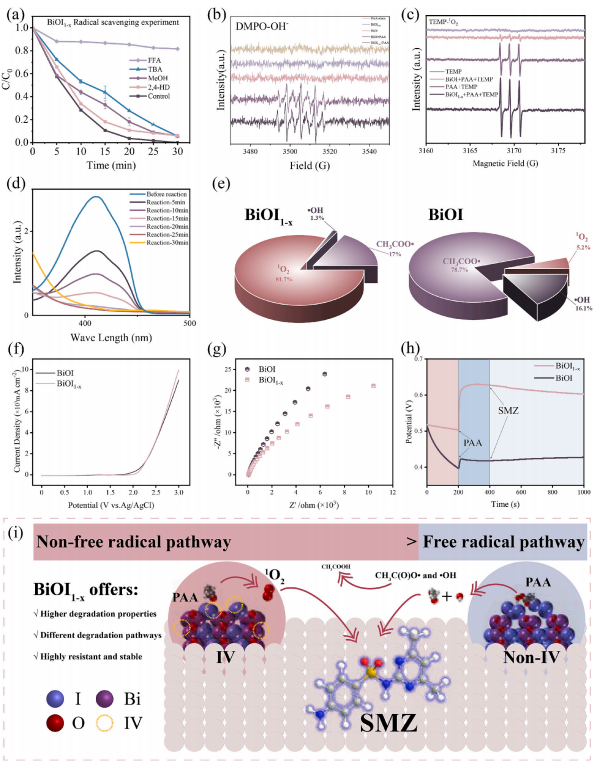
Fig. 3 (a) Free radical scavenging experiments with BiOI1-x, (b) DMPO-based EPR spectra for •OH in the BiOI/PAA system, (c) TEMP-based EPR spectra for 1O2 in the BiOI/PAA system, (d) DPBF results for the BiOI1-x, (e) the proportion of active species in the BiOI/PAA and BiOI1-x/PAA system, (f) LSV curves of BiOI and BiOI1-x electrodes, (g) EIS curves of BiOI and BiOI1-x electrodes, (h) OCPT curves of BiOI and BiOI1-x electrodes, (i) the possible mechanism of PAA degradation of SMZ catalyzed by the BiOI1-x/PAA system.
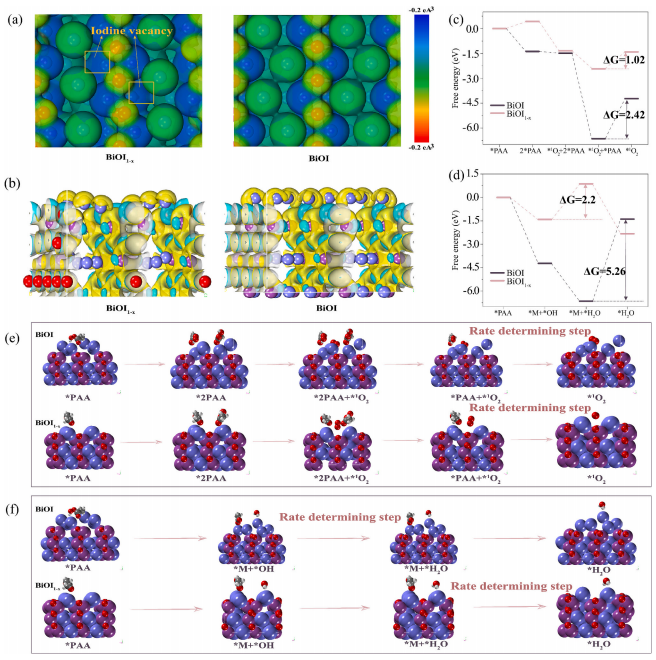
Fig. 4 (a) Electrostatic potential distribution of BiOI and BiOI1-x catalysts, (b) charge difference density plots for BiOI and BiOI1-x catalysts, (c) calculated Gibbs free energy for PAA activation on generating 1O2, (d) calculated Gibbs free energy for PAA activation on generating M and •OH, (e) the reaction steps for activating PAA to generate 1O2, (f) the reaction steps for activating PAA to generate M and •OH (M was the product of dehydroxylation of PAA).
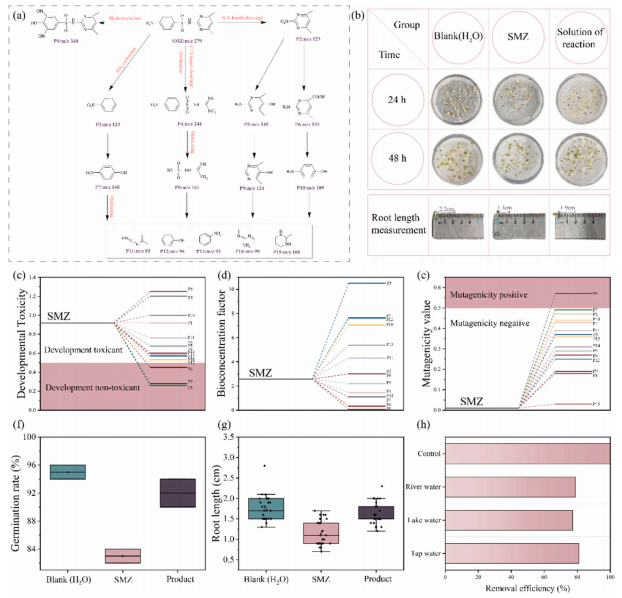
Fig. 5 (a) Proposed degradation pathways of SMZ by BiOI1-x/PAA process, (b) Growth of Chinese cabbage seeds cultured in the solution treated with different systems, (c) The developmental toxicity, (d) bioconcentration factor and (e) mutagenicity value of SMZ and its possible degradation intermediates, (f) Germination of seeds in different solutions, (g) Root length after seed germination in different solutions, (h) Removal efficiency of SMZ by BiOI1-x/PAA system in different water bodies.
小结:这项研究表明,合理设计BiOI1-x中的碘空位为PAA活化创造了一个变革性平台,在30分钟内实现了SMZ的完全去除。BiOI1-x/PAA系统将反应途径从自由基主导的过程转变为1O2成为主要的反应物种,通过探针分析进行了量化。密度泛函理论计算表明,这些空位重新配置了PAA吸附的几何形状,将1O2形成能垒降低了1.4 eV。通过在6个循环中保持>90%的效率和在94 L m-2 h-1通量下连续流动操作5小时,证实了实际可行性。白菜种子生物测定证明了环境安全,显示降解产物的发芽率>95%。建立了污染物电离势与反应动力学之间的强正相关关系,提供了一个通用的效率描述符。这项工作开创了阴离子缺陷化学超越传统自由基限制的先河,将缺陷工程从动力学增强推进到精确的反应控制,同时通过基于PAA的高级氧化提供可持续的抗生素修复。
【关闭】